
Blog posts
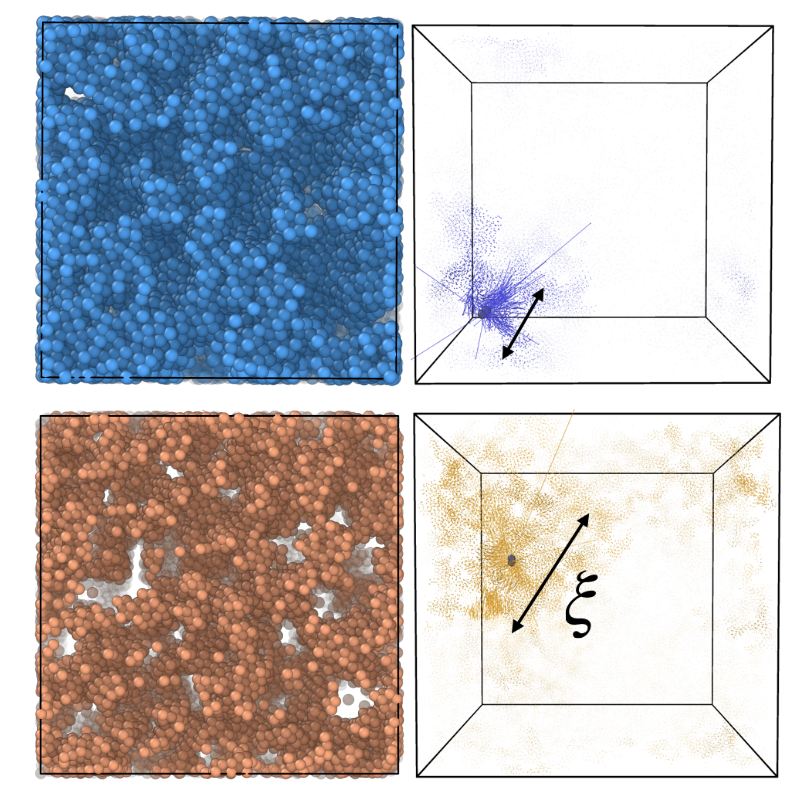
Mechanical heterogeneities in colloidal gels
Colloidal gels originate from solid objects with adhesive properties that are embedded in a fluid and self-assemble into a delicate percolating network. It is rather cumbersome to characterise the mechanical heterogeneities in these soft solids. Here, we demonstrate how to use both random walks and the linear response to dipole forces to investigate a critical length scale that diverges close to the rigidity percolation point. The displacement field associated with the local strain applied to the gel backbone highlights the growing heterogeneities close to the transition.
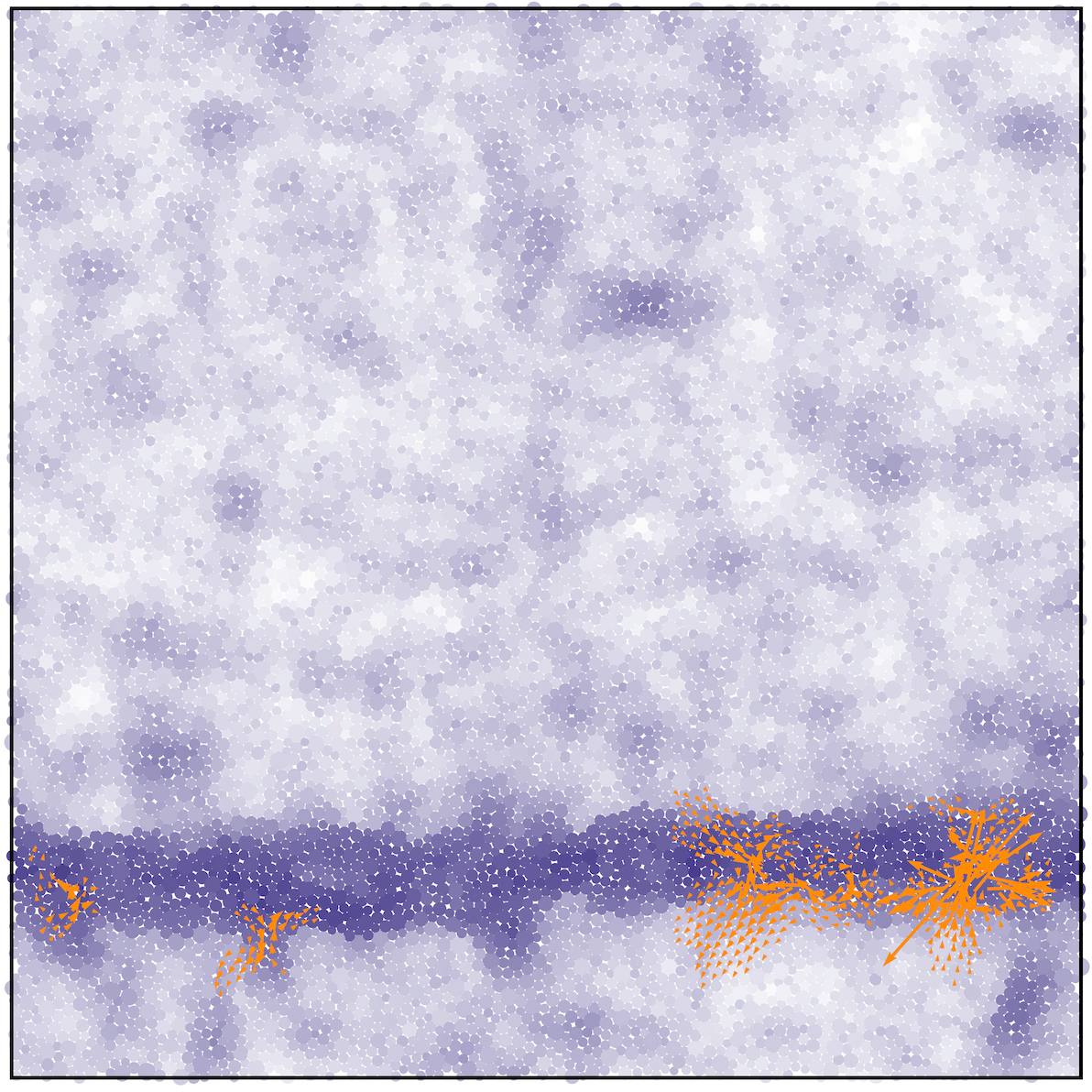
Micromechanics of non-linear modes
The micromechanics of non-linear modes (orange displacement field) allows one to measure the coupling between soft spots in structural glasses and predict the sequence of plastic instabilities prior to the nucleation of a shear band (blue cumulative plastic deformation).
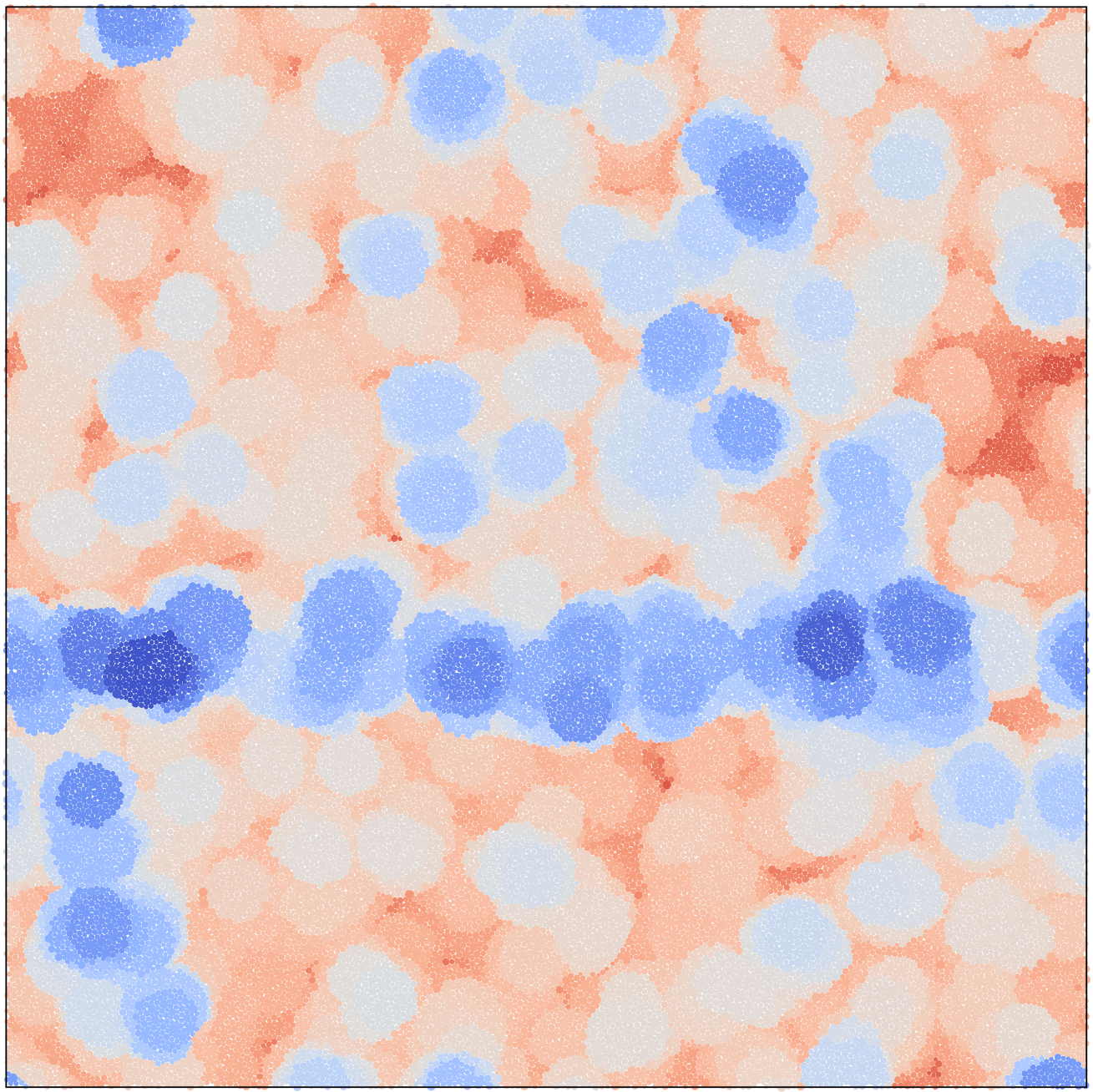
Local yield stress after shear banding
Local yield stress map extracted from an analytical nonlinear strain expansion of the stress inside spherical cavities that are embedded in a affinely deformed frozen matrix. Blue spots correspond to small stress activations, highlighting the presence of a permanent strain localization.
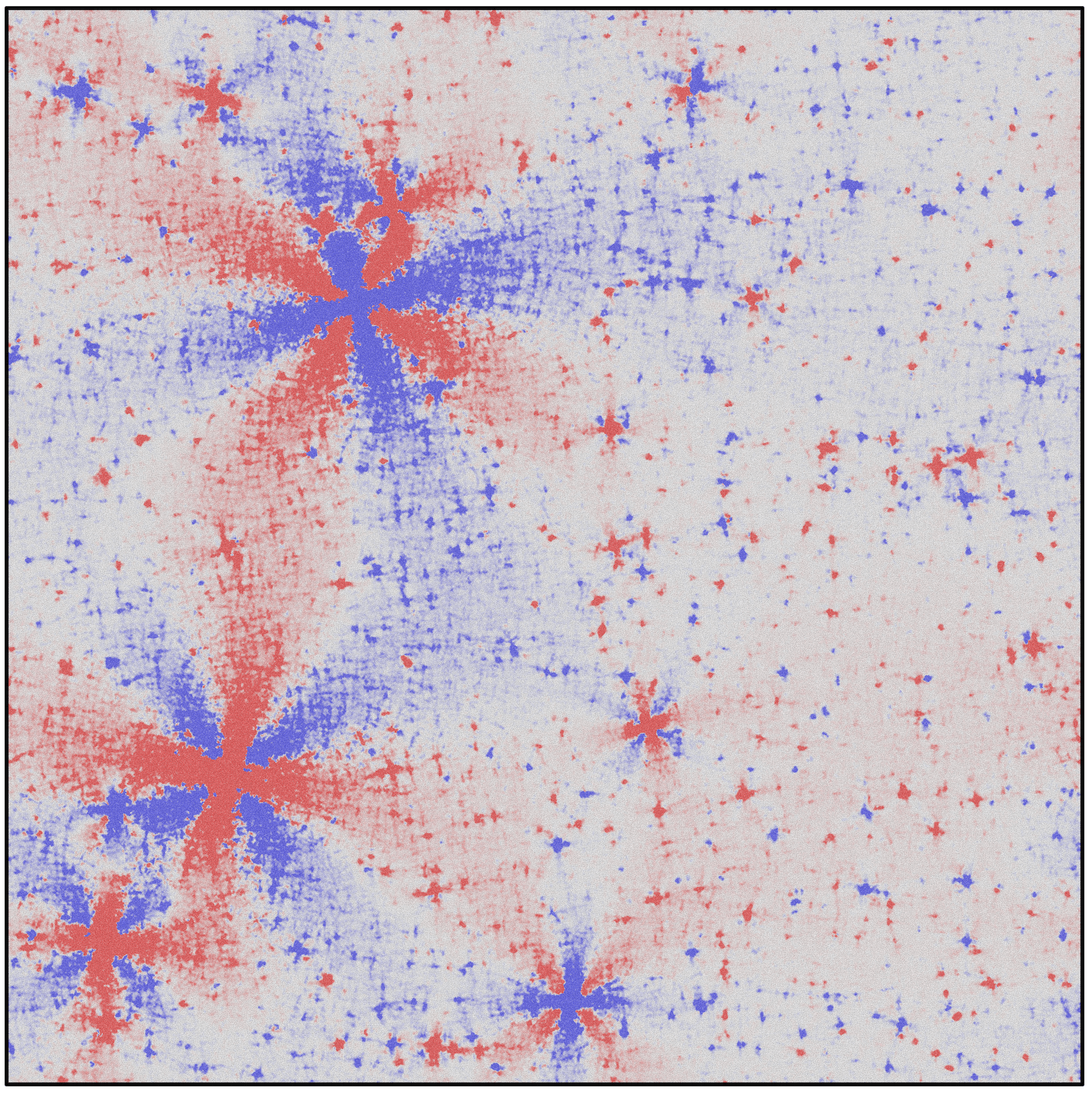
Tensorial plastic indicator
Local product between the first and second derivative of the potential energy with respect to the strain for a simple shear deformation. Blue and red regions will destabilize and stabilize upon loading, respectively. Large Eshelby-like fields mark the presence of soft defects.